
 en

Why Do I Have a Bounty? Explaining the League of Legends Bounty System

2 Nov, 2026, 03:04
|Last updated: 2 Nov, 2026, 03:04
Finding yourself ahead is one of the most euphoric feelings in League of Legends. But that invincibility comes crashing down fairly quickly when enemy champions finally manage to take you down – seizing the bounty placed on your head.
For nearly 15 years, League of Legends has played host to incalculable battles on the Rift and, for just as long, the Bounty System has been in play. Over the years, its shape has been shifted and reworked countless times — and yet it stands the test of time as an intrinsic mechanic of the game.
In October 2024, the latest reworked version of the Bounty System was released. Furthermore, Patch 25.09 in April 2025 further tweaked the system. Today, this guide will run through the inner workings of the system and explain one of the oldest and most fundamental mechanics in League of Legends.
*Last updated: 26/10/2026
What is the Bounty System in League of Legends?
The League of Legends bounty system is a system designed to reward Summoners (that’s you) with extra gold for taking down high-value targets. There are two distinct types of bounties that fall under this system: Champion Bounties and Objective Bounties.
Champion Bounties
Also known as the kill bounty, champion bounty is the more visible of the two bounty variants and is concerned with the gold worth of each individual champion in the game.
As of Patch 14.21, Champion Bounties are calculated based on gold earned and lost rather than kill/death streaks. In the previous system, champion bounties were decided based on tiers.
The higher the number of consecutive kills (or deaths), the higher the bounty tier given. This ranged from -6 to +8 with 0 set as the starting point.
But with the latest changes to the Bounty System, the tier system has been scrapped, and champion bounties are now accrued granularly. Bounties as small as +1 gold are now possible with the new system.
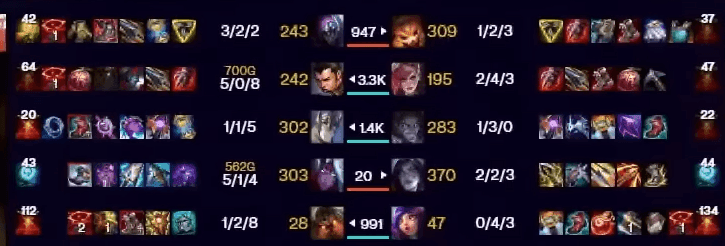
However, only bounties worth 150 gold and above will display on the scoreboard (updating in increments of +50 gold visually). Furthermore, champion bounties are distinguished into two categories:
- Positive Bounties
- Refers to the gold granted for killing an enemy champion. It is rewarded to the champion who deals the killing blow.
- Negative Bounties
- Refers to the devaluation of a champion’s kill gold (value). This occurs as the game progresses, beginning with an assumed value of 0 and reducing with each subsequent death.
Objective Bounties
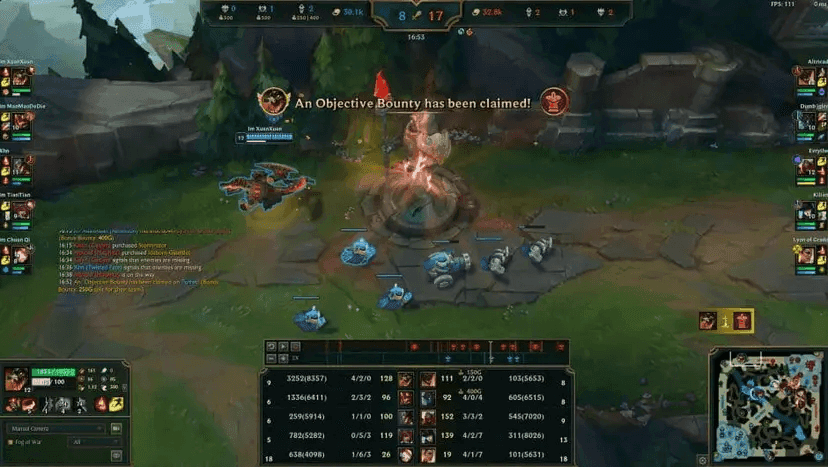
Unlike champion bounties, objective bounties are more team-oriented and have been designed as a comeback mechanic for the team that is behind.
This is done by providing bonus gold for capturing key objectives on the map (i.e. enemy turrets, epic monsters) and is activated for a period of time after a certain deficit threshold has been reached.
How are Bounties Calculated?
Now that we've gone over what types of Bounties exist in League of Legends, we need to understand how they are calculated so that we don't accidentally throw away leads or funnel a massive amount of gold into the enemy carry.
Champion Bounties
For Champion Bounties, we need to examine the difference between how positive and negative bounties are generated.
Positive bounties are generated and built through 2 methods primarily: farming well and scoring multiple consecutive kills without dying. The size of the bounty continues to increase over time as long as the methods continue and the champion is not slain.
It goes without saying then that slaying said champion collects the bounty — this is colloquially known as ‘shutdown gold’.
A champion is assumed to begin in a 'neutral' state. By generating a positive bounty, they trend towards a positive state. And the inverse will also be true: by generating a negative bounty, they trend towards a negative state.
Key Notes:
- A champion's base gold value is initially set at 300 gold.
- This scales up from level 7 to 18, 10 gold per level. Caps out at 420 gold as base gold value.
- Base gold value can be assumed to be the 'neutral' state and any deviation trends the champion either towards positive or negative state.
- A buffer of 100 gold is provided for all champions entering a positive state. This is to reduce variance of granting bounties close to the base value.
- Any amount in excess to base bounty + buffer amount = 'Shut Down gold'.
- Minimum 'Shut Down gold' is 50 gold.
- Extended Bounties: champions with bounties exceeding 700 gold will be placed in an extended bounty state. A single kill cannot reward more than 700 and the excess amount if applied to the champion on their next respawn.
- All bounties earned from kills and assists cannot increase mid-combat.
Here are all the ways for a champion to accrue a bounty:
- Kills and Assists
- 1 bounty gold per 3 gold earned
- Minions, Monsters, Support Item Generation (Gold-Value Sources)
- In Positive/Neutral state: 1 bounty gold per 20 GV-source gold.
- In a Negative state: 1 bounty gold per 7 GV-source gold.
- Deaths
- Bounty depreciates at a rate of 1 bounty gold per 3.5 gold distributed.
- If 'Shut Down gold' is claimed, bounty is full removed instead of depreciating.
Bounty Suppression
A new mechanic 'suppression' has also been introduced to Champion Bounties with this latest rework. Post 6-minutes of game time, Champion Bounty Suppression will activate.
While suppression is active, bounty payouts will be limited until a team is moderately ahead, at which point Shutdown gold will be restored for the winning team.
Team advantage is determined by a combination of gold, experience, and map objectives. Team Gold is given the highest weight/importance in determining whether a team is at an advantage over the other.
Objective Bounties
While the exact metric has not been disclosed, Objective Bounties are generated and presented for the losing team when behind by a combination of gold, experience, number of dragons slain, and number of turrets destroyed. A hard-set threshold is set from this combination, below which a team is considered to be 'losing'.
- Can only be activated after 14 minutes of game time have elapsed.
- Activates 60 seconds after a team drops below the threshold.
- Gold leads represent the biggest contributor to the metric on whether a team is 'losing'. Biggest weightage in Objective Bounty calculation.
- When Objective Bounties are active, 'Shut Down gold' is fully suppressed.
- Objective Bounties offer a baseline gold value and scale up to 60% based on how far behind the team is.
- Objective Bounties will deactivate after 60 second delay when the losing team is detected to have made a comeback (crosses back over the threshold).
- In situations where the losing team is 'coming back', Objective Bounties will still remain active but decrease in value by 20-40%.
Conclusion
The bounty system is an integral balancing mechanic meant to provide avenues for the losing team to come back into the game. Comprised of two cores, it is meant to reward both the individual and the team for proactivity in the face of adversity.
Mastery over this mechanic is crucial for climbing the ranks and bettering your understanding of the game. Not every game starts well. Neither will every game go your way. But every game is winnable.
Frequently Asked Questions
What is the bounty system in League of Legends?
The bounty system in League of Legends is the in-game comeback mechanic, adjusting to a team's advantage or disadvantage to maintain competitiveness between teams and giving opportunities for comebacks without severely punishing the leading team.
How much gold is a champion worth by default?
A champion is worth 300 gold by default and can rise in value up to 420 gold as a base bounty depending on their level. First Blood adds an additional 100 gold value on top of the base.
What does 'Shut Down' mean in League of Legends?
'Shut Down' refers to the death of a champion who has accrued a bounty value. When killing them, the bounty is removed and distributed among the champion who scored the kill and any who assisted.
Why do I have a bounty?
You gain a champion bounty by killing or assisting in killing champions primarily. You also accrue a bounty value by farming gold from minions, monsters and generating gold from the Support item.
I died so why do I still have a bounty?
Bounty values in excess of base bounty + 700 gold is referred to as 'Extended bounty state'. Because the maximum payoff for a single bounty collection is 700 gold, any excess amount beyond that carries over into a second bounty that is applied on respawn.
What is the point of the bounty system in League of Legends?
The bounty system is designed as the comeback mechanic within League of Legends, preventing early advantages from having too drastic an impact on one team snowballing to victory. This means losing teams can maintain a semblance of competitiveness while incentivizing winning teams to take calculated steps to secure victory.
Follow Strafe Esports for all the latest League of Legends news, and follow our X account for the latest content and coverage. Also, stay tuned to Strafe YouTube for exclusive interviews, press conferences, and more.
Feature image credit: Riot Games