
 en
en
Valorant Ranks Explained: Full List, Distribution & Matchmaking Guide (2026)

27 Jul, 2026, 03:00
|Last updated: 27 Jul, 2026, 03:00
Riot Games' 5v5 tactical shooter VALORANT remains one of the go-to games for many FPS gamers. Since its 2020 release, its blend of ease of entry and competitive ladder has attracted players from all corners.
Amongst various plus points that work in the favor of Valorant are easier game mechanics, unique and simple objective based gameplay, and a great matchmaking system amongst others.
Regardless of what many claim, VALORANT's matchmaking system remains of the best ones available. While it isn’t perfect (none of them are), it is one of the better ones to try your luck in thanks to Riot's continued tweaks to improve the climbing experience. Let’s deep dive into the world of VALORANT ranked and the ranks.
*Last updated: 24/7/2026
The Matchmaking System
Similar to multiple other SBMM (skill-based matchmaking) systems, VALORANT ranking is possibly based on Glicko-2 which is a modified ELO rating system. In the ELO rating system, an individual skill is quantified by comparing their dexterity to the masses.
Initially, a median rating is assigned, this rating is further adjusted after comparing the skill level of two players of the similar ELO rating bracket and the loser loses ELO points while the winner gains ELO points.
After multiple such continuous refinements, the ELO rating closely represents an individual skill rating.
In the case of Valorant, there are two ranking systems in place, a hidden MMR (matchmaking rating) and a visible rank. Let’s understand both these individually before exploring what they imply.
The Hidden Matchmaking Rating
The Hidden MMR in VALORANT is a value assigned to each player stating where they sit on the ranked ladder respective to every other player. This value is not viewable by any player and is the primary metric used when finding other players to create a lobby (matchmaking). Hidden MMR serves to match your 'value' with as many similiarly rated players to create the most balanced lobby possible.
Hidden MMR is separate to the individual’s rank and is often the cause behind visually disparate lobbies such as a Platinum and Silver players sharing a lobby despite the rank distance.
How is Hidden MMR Calculated for Valorant?
Whenever a new player first boots up VALORANT, they are met with a restriction from ranked until reaching Account Level 20. This is achieved by playing different available gamemodes such as Unrated, Deathmatch, Spike Rush, and so forth. This is the first instance of the game computing your skill based on your performance.
Once you become eligible to queue for the Competitive gamemode, the player must complete 5 placement games. The base hidden MMR established is then used to match the player for Game 1. If they do well in Game 1, they are highballed a much stronger opponent lobby for Game 2. If they struggled, then the opposite will occurs.
This pendulum swing will continue past the placement games, gradually reducing in variance until the game is 'confident' in your placement on the ladder through a large enough same size. It is important to note that individual good games carry less weight than consistency. Showing an improved baseline over multiple games is the fastest way to raise your Hidden MRR, thereby matching you in higher elo lobbies.
The Visible Rank
Once a player completes their initial 5 placement games, they earn their Visible Rank (e.g Gold 2). The visible rank represents your approximate skill bracket.
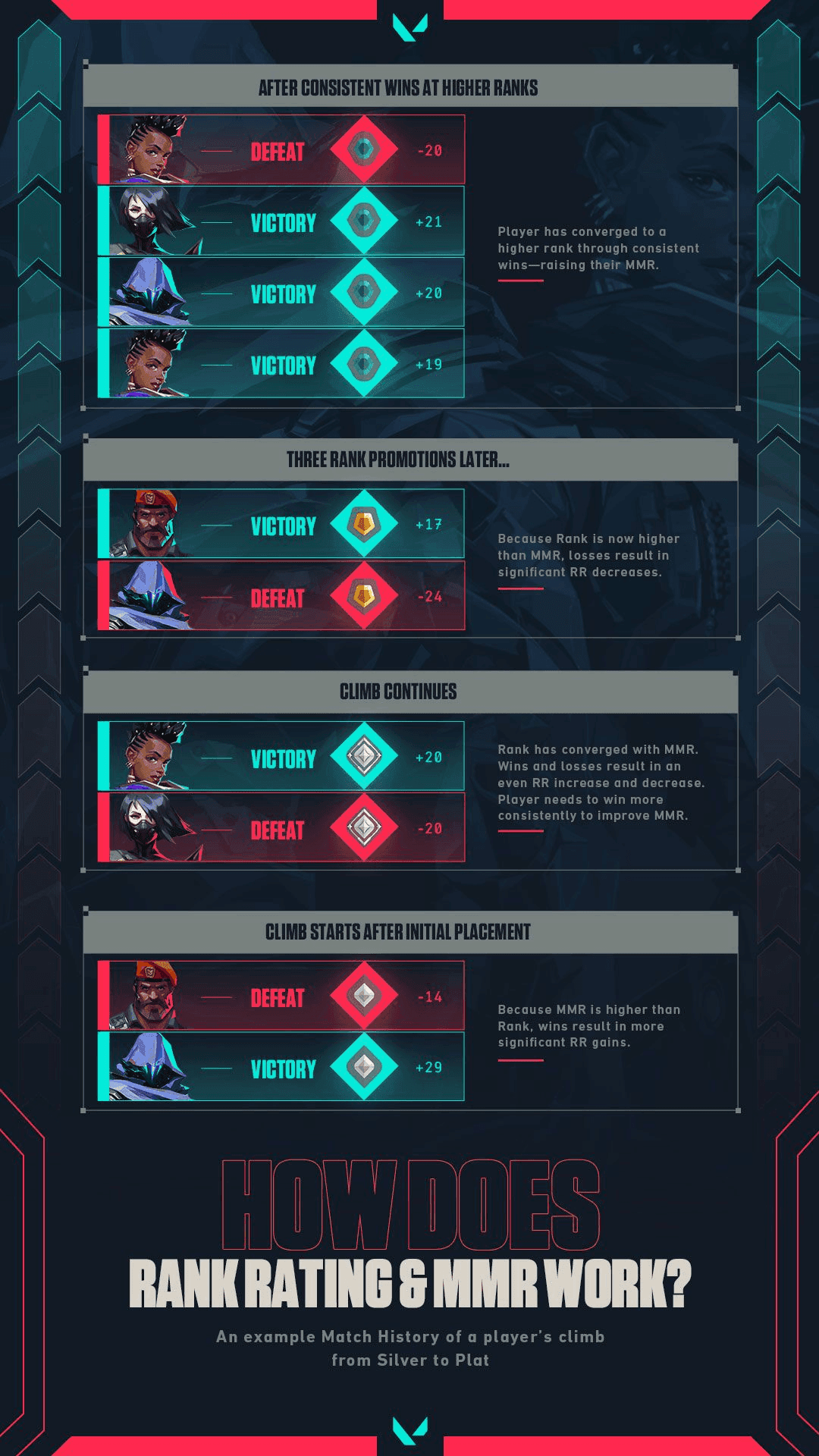
However, Hidden MMR will continue to be used as the primary metric for Matchmaking. Visible Rank comes into play to determine the player's gains and losses per match.
To put it simply, there are 3 states a player can be in:
- Hidden MMR aligned with Visible Rank
- Hidden MMR higher than Visible Rank
- Hidden MMR lower than Visible Rank
If the player's Hidden MMR is aligned with their Visible Rank, this is visualized by an even gain/loss of Rank Rating (RR). However, if the player's Hidden MMR is higher than their Visible Rank, the game will attempt to correct for this by 'accelerating' the player through the rank brackets, visualized through higher gains and lower losses of RR.
Finally, if a player's Hidden MMR is lower than their Visible Rank, the understanding is that they are not performing at the average expected for the skill bracket they are in. This is visualized by lower gains and higher losses of RR as the game attempts to bring the two back to alignment.
Starting from 2025, the Rank Shield system was introduced. When losing a demotion game to a lower Rank, instead of immediately dropping, players now have 2 additional 'shields'. Rank Shields only refresh on 1 of 2 conditions: either a player runs out of shields, deranks to the lower Rank and ranks back up, or when a player ranks up to a higher rank (e.g. Gold to Platinum).
Players can only hold a maximum of 2 Rank Shields at any time.
All Valorant Ranks
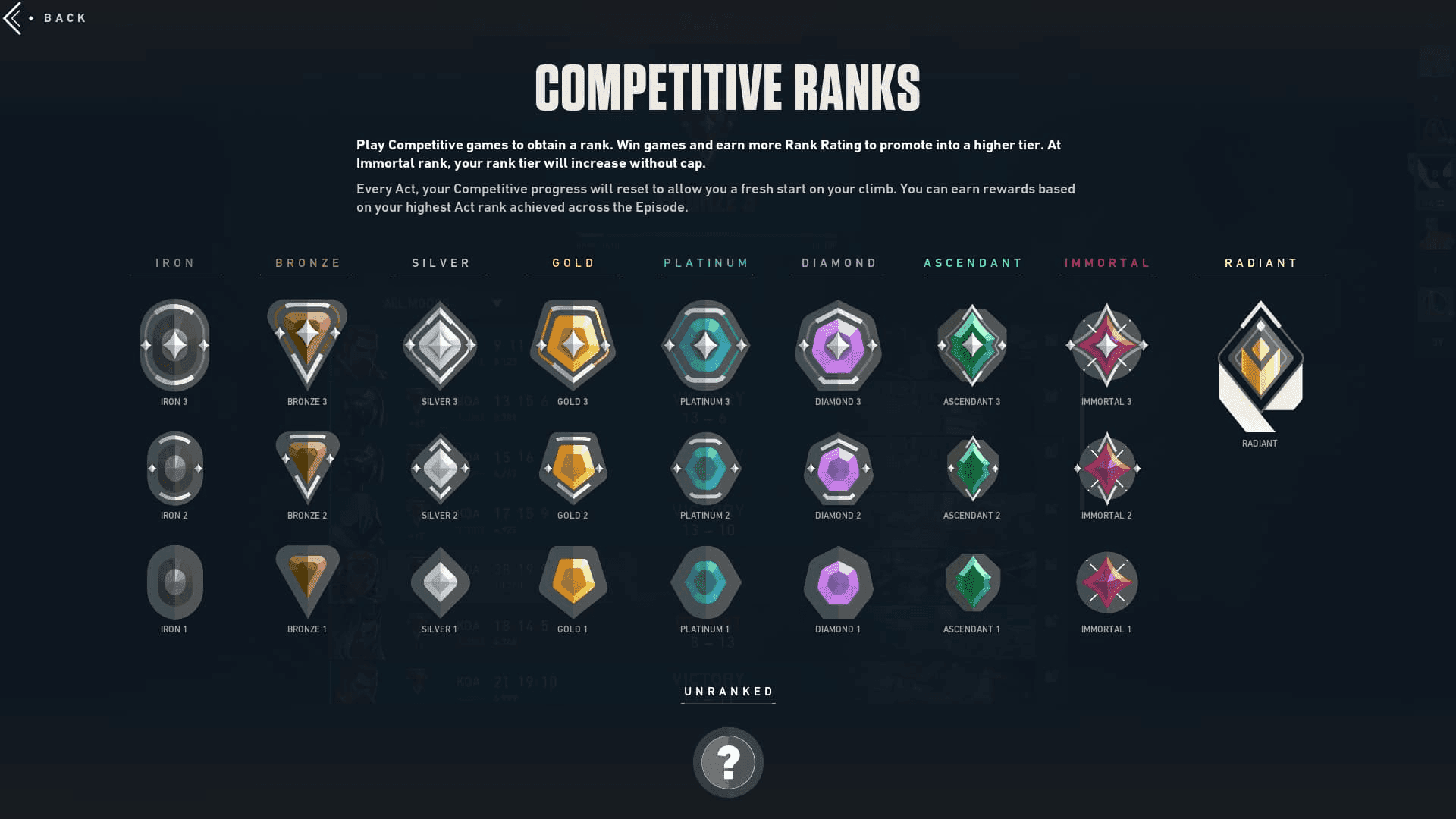
There are a total of 9 Skill Brackets (Ranks) in VALORANT.
- Iron
- Bronze
- Silver
- Gold
- Platinum
- Diamond
- Ascendant
- Immortal
- Radiant
Every aforementioned Rank has 3 divisions; so Iron will have Iron 1, Iron 2, Iron 3 and so on. To climb out of each division, a player needs a total of 100 RR, and to climb out of each Rank, 300 RR.
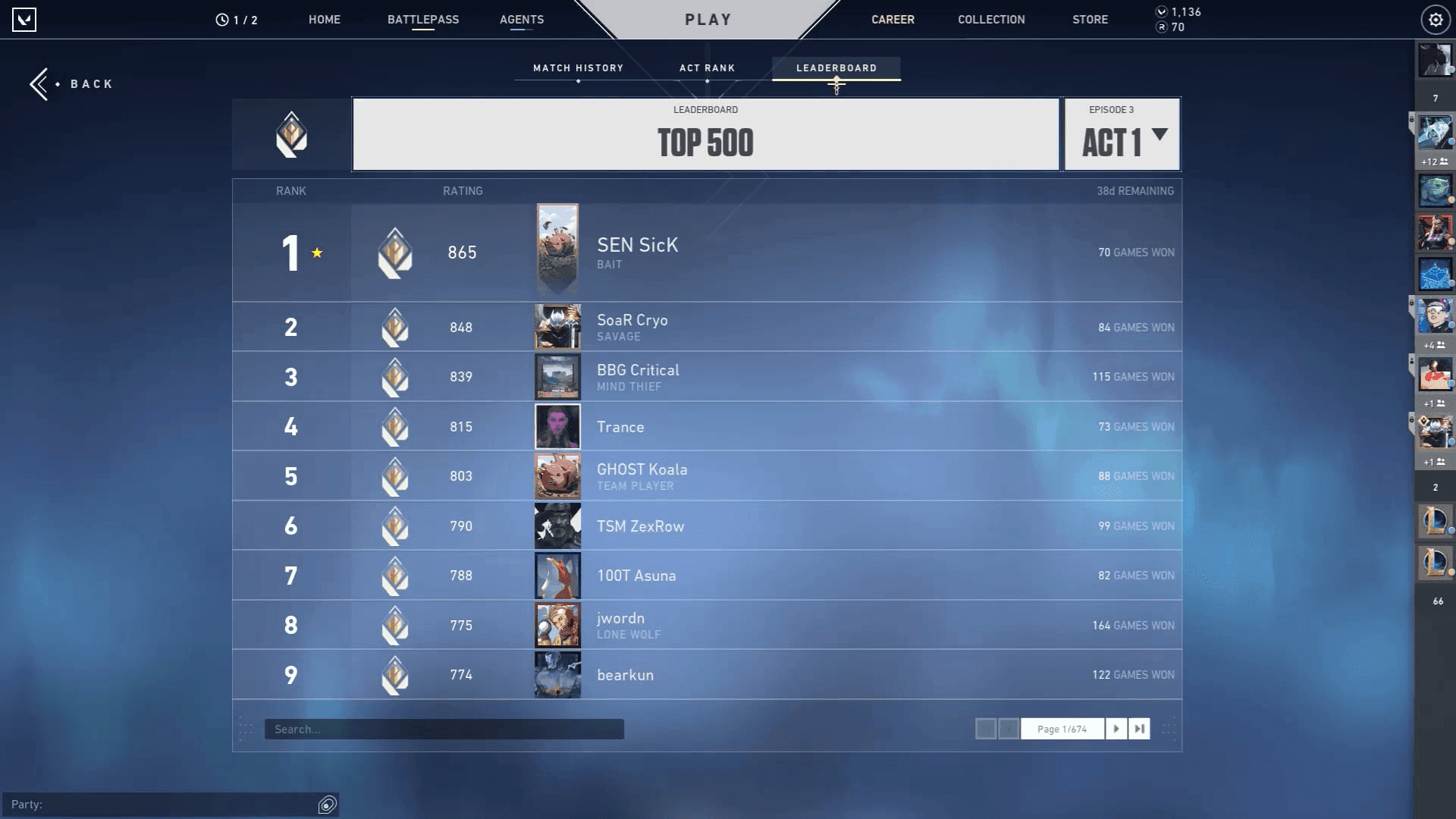
Starting from Immortal, RR begins to compound between divisions (0-100 for Immortal 1, 101-200 for Immortal 2, 201+ for Immortal 3). For Radiant, there is no set numerical threshold to qualify. The top 500 players in their region with the most total RR qualify on the leaderboard as Radiant.
Naturally, the threshold for qualifying as a Radiant is different for every region too. Beginning from Immortal 1 upwards as well, players will be placed on the Ranked Leaderboard.
Both Hidden MMR and Visible Ranks see manual adjustments over the course of the year, split into Soft Resets and Hard Resets. Starting from 2025, each year is now considered a 'Season' comprising of 6 Acts (each ~2 months long ). At the start of every act, the player will go through a Soft Reset, where they will need to complete 1 Competitive game to reveal their Visible Rank again.
The Season is split into 2 'Episodes' comprised each of 3 Acts. Both Act 1 and 4 act as markers for the Season Start and Mid-Season respectively. Ranks will undergo a Hard Reset at the start of those acts, where players will have to complete their 5 placement games once again.
The highest individual rank achievable after the Hard Reset is Ascendant 3. Players have to climb out of their respective rank reset to get back to their original rank. The rank reset helps maintain a good balance of player rank distribution.
Understanding the Ranks
The Iron and Bronze ranks are filled with players who are still learning the game mechanics. These players are getting to know how the movement and shooting works.
Silver-Gold represents players who are currently learning maps, map angles, agent mechanics and more. Platinums have everything down and work on sharpening their skills further.
Diamond and above is more about grinding through the ranks, there is obviously a difference in the experience, but as one plays regularly, the game sense and the mechanics sharpen.
Valorant Rank Distribution
| Rank | Distribution | Combined Distribution |
|---|---|---|
| Iron 1 | 0.863% | 8.167% |
| Iron 2 | 2.428% | |
| Iron 3 | 4.876% | |
| Bronze 1 | 7.002% | 22.31% |
| Bronze 2 | 8.520% | |
| Bronze 3 | 6.788% | |
| Silver 1 | 8.114% | 22.217% |
| Silver 2 | 7.287% | |
| Silver 3 | 6.816% | |
| Gold 1 | 8.541% | 20.927% |
| Gold 2 | 6.954% | |
| Gold 3 | 5.432% | |
| Platinum 1 | 5.806% | 13.75% |
| Platinum 2 | 4.548% | |
| Platinum 3 | 3.396% | |
| Diamond 1 | 3.726% | 8.729% |
| Diamond 2 | 2.941% | |
| Diamond 3 | 2.062% | |
| Ascendant 1 | 1.868% | 3.308% |
| Ascendant 2 | 0.937% | |
| Ascendant 3 | 0.503% | |
| Immortal 1 | 0.376% | 0.564% |
| Immortal 2 | 0.095% | |
| Immortal 3 | 0.093% | |
| Radiant | 0.029% | 0.029% |
*Sourced from Tracker.gg
As seen from the rank distribution, over 60% of VALORANT's playerbase sits within the Bronze-Gold range. Only about 25% of the playerbase occupy the next 3 Ranks of Platinum-Ascendant. The upper echelon of VALORANT (Immortal-Radiant) comprise less than 0.6% of the entire playerbase.
More than 70% of players belong to the average skill, which is a sign of a stable matchmaking system. The combination of Hidden MMR/Visible Rank and regular resets maintain the balance and regularly flush the ladder of bad actors such as boosted accounts and smurfs.
How to Consistently Rank Up in VALORANT?
The first and most important way to rank up is individual training. One must continuously train their aim, crosshair placement, positioning and movements to get better at the base skill set of Valorant. Most players utilize The Range for individual mechanical sharpening.
Deathmatch is an efficient way to practice, additionally, mixing Deathmatch with Team Deathmatch helps you practice multiple angles and weapons. They also help with agent abilities, providing an individual with a complete practice experience.
Another major factor in consistently ranking up in Valorant is practice. Regularly playing the game and experiencing multiple agents can help you understand the games from different perspectives. Knowledge of different maps in the pool aids with performance consistency game to game.
Once you are ready individually, playing competitively is getting into a cesspool of players that come from different places and hence might not have the same set of skills or the same attitude towards the game.
The difference can lead to friction, so a better way to rank up is finding a consistent partner(s). Ranked players regularly have 'duos' or a set of players that they queue with frequently. Queing with already known players removes one unknown quantity from players' Ranked experience
Regardless of how many you choose to queue with, ensure your attitude towards the game matches with each other. Expectations for game results differ player to player as it does in Solo Queue, only when duoing or trio-ing or 5-stacking, that should be an element that is more manageable.
Queuing Restrictions in Valorant
VALORANT has built-in party restrictions for the Competitive gamemode. Player can queue as 2, 3, or 5. 4-stacks are not allowed. Below is a table of the rank range party restrictions.
| Rank | Range |
|---|---|
| Iron 1-3 | Iron 1- Silver 3 |
| Bronze 1-3 | |
| Silver 1-3 | Iron 1 - Gold 3 |
| Gold 1-3 | Silver 1 - Platinum 3 |
| Platinum 1-3 | Gold 1 - Diamond 3 |
| Diamond 1-3 | Platinum 1 - Ascendant 3 |
| Ascendant 1-3 | Diamond 1 - Immortal 3 |
| Immortal 1-3 | Ascendant 1 - Radiant |
| Radiant | Immortal 1 - Radiant |
The queue restriction is set at one full Rank at Platinum and up. This means a Platinum 1 player can queue with a Diamond 1 player but not a Diamond 2 or 3.
Immortal and Radiant Party Restrictions
Immortals and Radiants are only allowed a 2 or 5-person party on top of the Rank range restriction.
5-Stack Party Restrictions
There are no queue restrictions for 5-person parties in that as long as there are 5, the rank does not matter and players will be allowed to queue. However, there are penalties affecting RR gains/losses depending on the rank of individual party members. All members of the party will incur a 25% reduction if one of the following conditions are met:
- If at least one member of the party is outside the Rank range restriction. (e.g 4 Silver-Gold and 1 Platinum).
- If at least one member of the party is Immortal Rank.
Furthermore, the party is fully Radiant, the party incurs a 75% reduction. That penalty rises to 90% if any players in the party is ranked below Radiant.
If you can’t find a stack, a duo or trio is a better way to play. If you have to SoloQ, here are a few tips to ensure you have the best experience possible.
- Maintain utmost composure.
- Communicate as much as possible with your teammates, starting with agent select.
- Cooperate with your teammates and try to play your best game.
Hope that helps with your Valorant Ranked experience, and your understanding of rank is now improved.
Frequently Asked Questions
How many ranks are in Valorant?
Valorant has 9 ranks: Iron, Bronze, Silver, Gold, Platinum, Diamond, Ascendant, Immortal, and Radiant. Every rank except Radiant has 3 divisions, for 25 total rank tiers.
What is Hidden MMR in Valorant?
Hidden MMR is an invisible rating value Riot uses to build matchmaking lobbies. It's separate from your visible rank and is the main reason you'll sometimes see mismatched ranks, like a Platinum and a Silver player, in the same lobby.
What's the difference between Hidden MMR and Visible Rank?
Visible Rank is the badge on your profile and determines how much RR you gain or lose. Hidden MMR is what actually drives matchmaking. When the two are out of sync, the game adjusts your RR gains and losses to pull them back into alignment.
How much RR do you need to rank up in Valorant?
You need 100 RR to climb a division and 300 RR total to climb a full rank. From Immortal onward, RR compounds across divisions instead of resetting each time.
How do you reach Radiant in Valorant?
There's no fixed RR threshold for Radiant. It's a regional leaderboard rank reserved for the top 500 players by RR in a given region, so the cutoff shifts constantly depending on how competitive that region's ladder is.
How often do Valorant ranks reset?
Since 2025, each year-long Season runs across 6 Acts. Every Act brings a Soft Reset requiring one placement match, while the start and midpoint of the Season bring a Hard Reset requiring five placement matches.
What's the difference between a hard reset and a soft reset?
A soft reset hides your rank until you complete one placement match, with minimal MMR adjustment. A hard reset happens twice a season, requires five placement matches, and typically drops your visible rank a tier or two below where you finished.
What ranks can play together in Valorant?
It depends on party size. Duos and trios follow a rank-range restriction that widens as you climb (for example, Gold can queue with Silver through Platinum). Immortal and Radiant players are restricted to solo, duo, or five-stack parties only. Five-stacks can queue at any rank spread but face RR penalties for large gaps.
Can you queue as a four-stack in Valorant ranked?
No. Riot removed four-stack parties because they consistently put solo players against a coordinated four-person team, creating unbalanced matches.
What percentage of Valorant players reach Immortal or Radiant?
Based on current tracker data, Immortal and Radiant combined make up under 0.6% of the ranked player base, making them the rarest ranks in the game.
Follow Strafe Esports for the latest Valorant news, and our X account for the latest content and coverage. Also, stay tuned to Strafe's YouTube channel for exclusive interviews, press conferences, and more.
Featured Image Credits: Riot Games