

 en
en
VALORANT Performance Score Explained: How the New ACS Replacement Works

28 Sep, 2026, 18:17
|Last updated: 28 Sep, 2026, 18:17
In September 2026, VALORANT replaced Average Combat Score (ACS) with Performance Score, a new metric designed to recognize players who contribute to their team through abilities, trades, and other impactful actions rather than focusing solely on kills.
Performance Score vs. Average Combat Score
Before looking at how Performance Score works, it is important to compare it with Average Combat Score and understand how the two systems differ.
| Average Combat Score | (NEW) Performance Score | |
| Score Range | Open-ended (typically ~0-400+ per match) | Fixed scale (0-500) |
| Primary Focus | Heavily weighted towards kills, multi-kills, and damage output | General contribution, including utility usage, support play, and non-damage impacts |
| Role Bias | Strongly favored Duelists and aggressive fraggers | Balanced across all Agent roles |
| First Blood | High fixed bonus (+200 to +150 depending on living enemies) | Integrated into broader context-based situational performance metrics |
| Progression Integration | Stat tracking only | Directly awards Mastery Points (MP) for Agent Mastery and feeds into Accolades |
| Breakdown Transparency | Simple formula shown per round in the Combat Report | Detailed post-match breakdown in the End of Game screen showing areas of improvement |
What is the Performance Score?
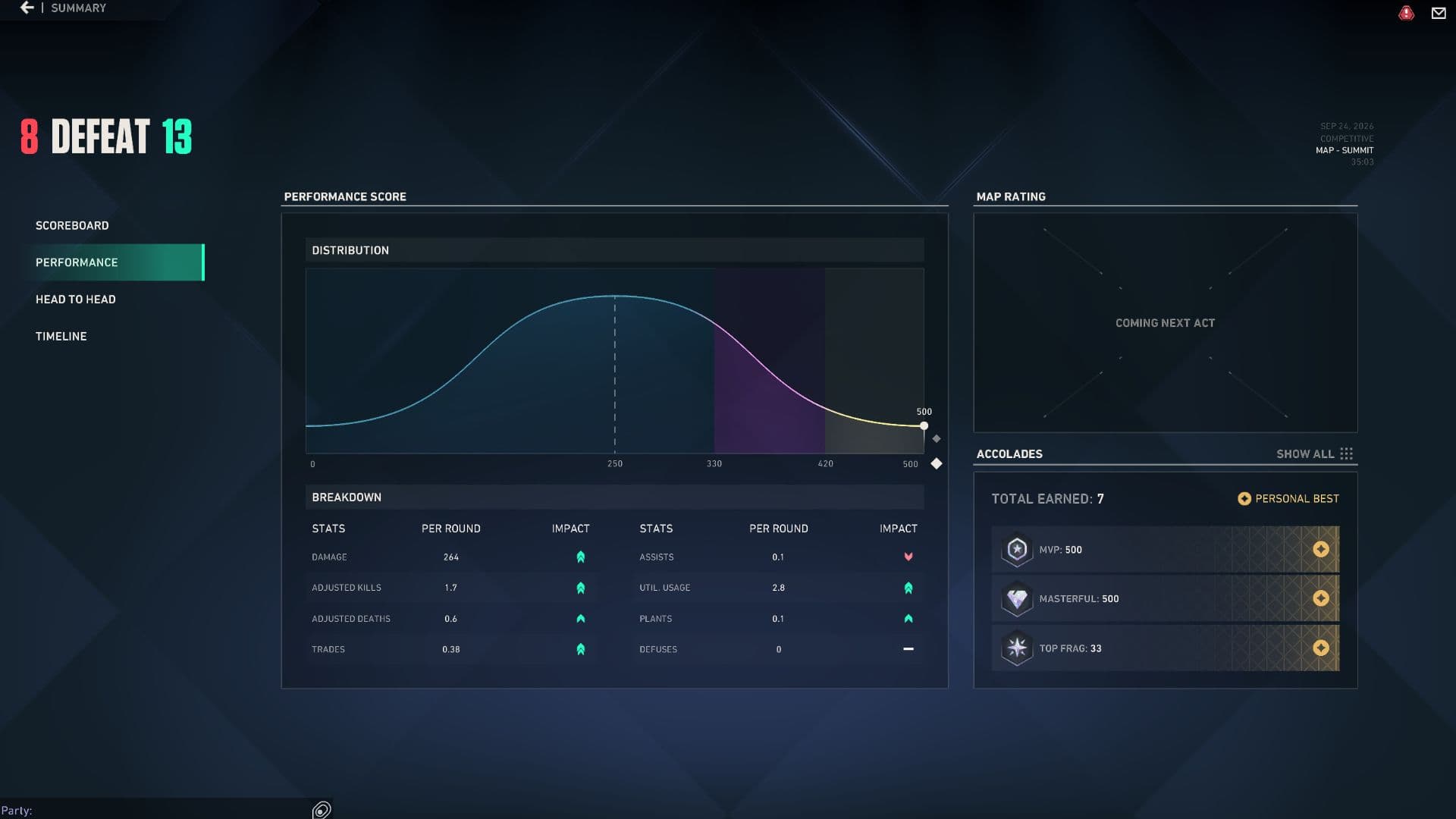
The Performance Score, introduced in Patch 13.06, is a 0–500 rating that measures more than just damage and kills, providing a broader view of a player's contributions throughout a match.
On the End of Game screen, players can see how impactful they were, identify areas for improvement, and see how close they came to achieving a Masterful performance.
The Most Valuable Player (MVP) of a match will now be determined by the Performance Score, alongside the player’s position on the scoreboard.
How to Increase the Performance Score
While kills no longer carry the same weight they did under the Average Combat Score system, they are still an important part of the Performance Score system.
However, other in-game interactions are also taken into account to provide a more complete measure of a player's impact during a match. So, what actions increase the Performance Score?
- Securing kills or multi-kills in a single round
- Dealing damage to enemy health or shields, even if it doesn't lead directly to a kill
- Spotting an enemy with an ability and eliminating them (e.g. Cypher's Spycam, Sova's Recon Bolt, Fade's Haunt)
- Flash and concuss enemies with abilities shortly before you or a teammate eliminates them
- Dealing damage with abilities (Raze's Paint Shells, Brimstone's Incendiary, etc.)
- Restoring health to allies (Sage, Skye, Miks)
- Blocking the enemy's line of sight with smoke or a wall
- Applying debuffs (Vulnerable, Decay, or Suppressed) to enemies who are then engaged by your team
- Planting/Defusing the spike
- Eliminating an enemy shortly after they kill a teammate (trade)
- Winning clutch situations (1v1, 1v2, 1v3, etc.)
- Winning the rounds
How 'Trades' Work in the Performance Score System
Under the ACS system, dying without securing a kill was treated as a negative contribution, while the player who traded you only received basic frag and damage credit.
The Performance Score system changes how trades are evaluated by measuring team-fight synergy and trade efficiency through two metrics:
- Securing a Trade (Trade Kills): Eliminating an enemy shortly after they kill one of your teammates provides a performance boost. This rewards players who stay close enough to support site entries and quickly re-frag lost engagements rather than playing too far from the action.
- Being Traded (Traded Deaths): Dying during an entry or frontline engagement is no longer as heavily penalized when a teammate immediately trades your death. If your death creates an easy re-frag opportunity, the system recognizes the value of your initial engagement and reduces the penalty typically associated with dying.
By tracking both trade kills and traded deaths, Riot Games' system places greater value on coordinated team play. It rewards players who trade efficiently while discouraging baiting and encouraging teammates to fight together and support each other in engagements.
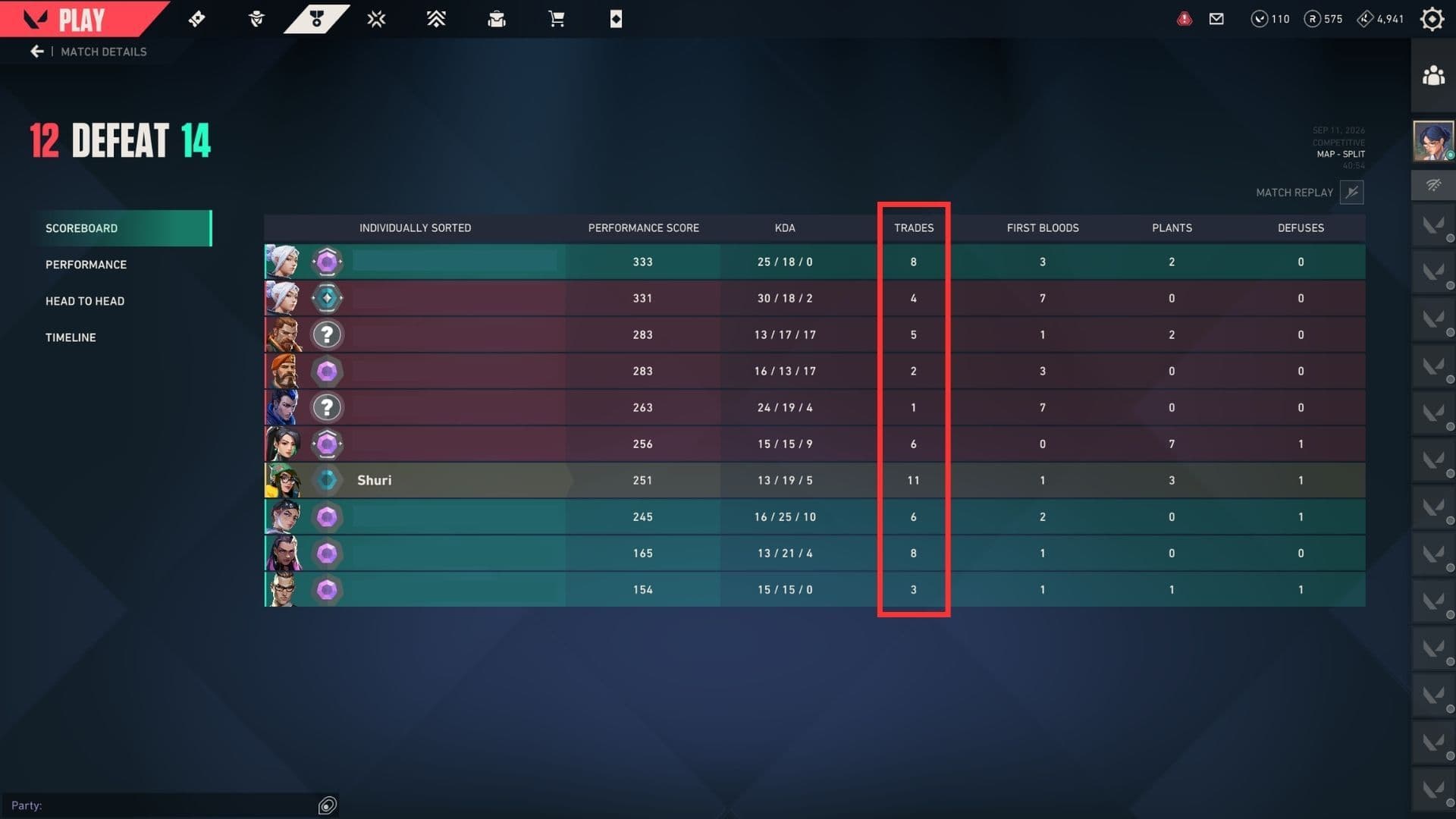
In this example, although I had fewer kills than my teammates, my 11 trades contributed to my Performance Score, highlighting my role in coordinated team plays.
Frequently Asked Questions
Where can I see my Performance Score during and after the match?
During the match, your relative standing is reflected on the scoreboard. After the match, a full breakdown is displayed on the redesigned End of Game screen, showing your final score out of 500, specific contributions, areas for improvement, and how close you were to a "Masterful" rating.
Does Performance Score affect how much Rank Rating (RR) I gain or lose?
No. Riot Games clarified that Performance Score is strictly a scoreboard, MVP, and end-of-game feedback metric. Your Rank Rating (RR) gains and losses are still determined by match wins, losses, and hidden Matchmaking Rating (MMR).
Does Performance Score scale identically across every Agent role?
The total scale is the same for everyone, but the metrics used to calculate it are tailored to individual Agent kits. Initiators and Controllers earn significant performance value from utility, while Duelists earn a higher portion of their score from first kills and damage output.
Can I hit a Performance Score higher than 500?
No. Unlike ACS, which was open-ended and could exceed 400+, Performance Score uses a fixed scale capped at 500.
Can you get a Performance Score of 0?
While extremely rare, it is technically possible if a player contributes virtually no damage, utility value, trade setup, or objective interaction across a match.
Does out-fragging everyone guarantee match MVP under the new system?
Not necessarily. Because Performance Score weighs utility usage, combat assists, and objective plays alongside kills, a player with fewer frags but higher overall round impact can earn MVP over a high-kill player.
Does getting traded count toward my Performance Score?
Yes! Performance Score evaluates team fighting and trade efficiency. Being traded by a teammate shortly after you die counts as a positive contribution (a "Traded Death"), penalizing you less than dying alone in an isolated, untradeable location.
Which game modes use Performance Score?
Performance Score is active in Competitive, Unrated, Swiftplay, and Premier. Arcade modes like Deathmatch and Spike Rush do not utilize it to dictate scoreboard placement.
Follow Strafe Esports for the latest Valorant news, and follow our X account for the latest content and coverage. Also, stay tuned to Strafe's YouTube channel for exclusive interviews, press conferences, and more.
Featured Image Credit: Riot Games