
 en
en
Valorant Veto Agent Guide: Abilities, Playstyle & Tips

10 Jun, 2026, 09:09
|Last updated: 10 Jun, 2026, 09:09
Veto is Valorant's 29th agent, a Sentinel who disrupts the enemy team rather than simply watching angles. His kit traps, deafens, decays, and repositions in ways no previous Sentinel has done. If you want Sentinel utility without anchoring one site all game, this guide covers every ability, team compositions, map ratings, counter tips, and five practical tips to get you started.

Who is Veto? Background and lore
Veto is Agent 29 in the Valorant protocol, released on October 7, 2025 in patch v11.07b. He is Senegalese by origin and the third African agent on the roster after Cypher and Astra. His codename reflects what he does in a match: he vetoes the enemy team's plans.
His lore centers on a Radivore mutation, a condition where his body absorbs radianite rather than being destroyed by it. Crosscut vortexes, biological traps, and his full-mutation ultimate all come from that condition.
Visually, Veto is lean and angular, with a design language that mixes Senegalese cultural references with the warped, organic aesthetic of his mutation. He sits in the Valorant Sentinel role by classification, but he plays more aggressively than most Sentinels. You can see where he sits among all current Valorant agents if you want a full roster comparison.
Veto's abilities, full breakdown
Here is a quick-reference table for all four abilities before the detailed breakdowns below.
|
Key |
Ability name |
Type |
One-line description |
|
C |
Crosscut |
Basic |
Deployable vortex teleport, recallable in buy phase |
|
Q |
Chokehold |
Basic |
Thrown trap that holds, deafens, and decays enemies |
|
E |
Interceptor |
Signature |
Deploys Phage device that destroys incoming enemy utility |
|
X |
Evolution |
Ultimate |
Full mutation with combat stim, regen, and debuff immunity |
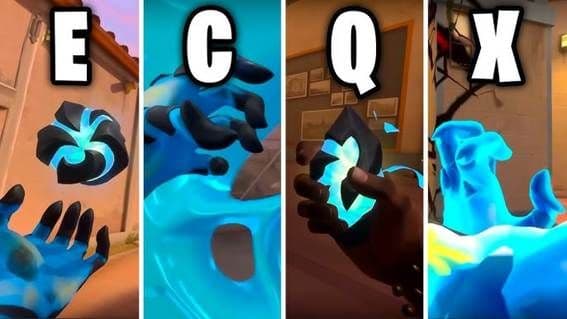
Crosscut (C), basic ability
Crosscut costs 200 credits per vortex, with two charges available per round for 400 credits total. You deploy a vortex on the ground and teleport to it by looking at it and pressing the reactivation key. You can recall the vortex during the buy phase and redeploy it elsewhere.
The main difference from Yoru's Gatecrash is activation method. With Crosscut, you must look directly at the vortex to activate it. You need a clear line of sight to your own vortex, which makes accidental teleports rare but also means walls and smokes block it.
Use Crosscut for retakes and mid-round rotations. Place it at a site before the round starts, then recall and reposition once you know where the attack is going. Leaving it in the same spot every round makes you predictable.
Chokehold (Q), basic ability
Chokehold costs 200 credits. You throw a viscous fragment that lands as a trap. When an enemy walks into it, the trap holds them in place, deafens them, and applies a Decay debuff that chips their health over time.
Enemies can destroy Chokehold before it activates, so placement is everything. Dark corners, the far side of doorways, and angles that players check last are the best spots. Deafen cuts the trapped player's ability to hear callouts, and Decay gives your team a health-reduced target. Stay close enough to follow up before the effect runs out.
Interceptor (E), signature ability
Interceptor is Veto's free signature ability. You deploy a device called Phage at a location. When enemy utility bounces off a player or ends naturally near the Phage, the device destroys it instead of letting it activate.
Phage has 20 HP and can be shot by the enemy. Tucking it behind cover where enemies cannot shoot it from safety is the core skill. Against Sova, Breach, Skye, and Fade, Interceptor removes the utility those agents rely on to take space. That is the primary use case.
Evolution (X), ultimate ability
Evolution costs 7 ultimate points. When activated, Veto undergoes a full mutation instantly. The ability gives him a combat stimulant, health regeneration, and complete immunity to all debuffs for the duration.
The immunity covers flashes, stuns, slows, deafen, and decay. Veto still takes full bullet damage, including from Jett's Bladestorm knives, Chamber's Tour de Force, and Neon's Fast Lane.
Evolution fits two situations: solo entry when the enemy has layered utility ready, or holding a site during a retake at a numbers disadvantage. The common mistake is saving it too long. Activating it early enough to fight back is better than saving it and losing the round.
Compare this ability to Vyse's kit by reading the Vyse abilities guide for another Sentinel with a contrasting playstyle.
How to play Veto, playstyle guide
Veto's Sentinel classification is accurate on paper, but his play looks different from Killjoy or Cypher. Those two agents commit to a site and anchor it. Veto moves.
The core loop on defense: place Chokehold at the most likely entry point, position Phage where enemies throw utility, and set Crosscut at a spot you need to reach fast if the site gets hit. Stay near your traps. A Chokehold that triggers with no one nearby to follow up is wasted.
On attack, use Interceptor to block Sova drones or Breach aftershocks. Use Chokehold on off-angles in mid to catch rotating defenders. Crosscut lets you exit a site quickly when a retake comes while you are planting.
Veto does not lock one site and stay there. He covers angles across multiple chokepoints and rotates using Crosscut. That mobility means he requires more round-by-round decision-making than a standard anchor Sentinel.
Best team compositions with Veto
|
Comp style |
Suggested agents |
Why it works |
|
Aggressive push |
Breach, Jett, Omen, Veto, 1 flex |
Breach stuns layer with Veto's Deafen for zero-information pushes |
|
Retake-focused |
Fade, Reyna, Astra, Veto, 1 flex |
Crosscut lets Veto rotate fast while Fade's info compounds Chokehold trap timing |
|
Anchor and control |
Sage, Skye, Neon, Veto, 1 flex |
Sage wall plus Chokehold creates layered site denial at chokepoints |
The aggressive push comp works because Breach stuns and Veto's Deafen create a window where enemies have no information. Jett entries on that window, Omen smokes before it opens.
The retake comp leans on Crosscut's speed. Fade finds where the enemies are, Veto repositions with his vortex, and Reyna finishes off health-reduced targets from Chokehold's Decay.
The anchor comp is the most traditional setup here. Sage wall blocks one entrance, Chokehold covers the next, and Skye's heals keep the team healthy.
Best maps for Veto (and maps to avoid)
|
Map |
Verdict |
Why |
|
Fracture |
Strong |
Dual-side attack creates repeated chokepoint pressure. Crosscut suits the split-site layout. |
|
Lotus |
Strong |
Three sites with rotating doors. Chokehold holds rotations and punishes door timings. |
|
Breeze |
Situational |
Long sightlines reduce trap value. Crosscut still helps with rotation speed. |
|
Abyss |
Weak |
Multiple entry routes per site spread Veto's traps thin, similar to Killjoy's weakness here. |
Fracture and Lotus funnel attacks through identifiable chokepoints. Chokehold works best when you can predict where enemies walk, and both maps have corridors and doors that create those predictions. Breeze's open sightlines mean Chokehold gets spotted and shot from range. Abyss has too many approach angles per site for Veto's trap count to cover.
How to counter Veto
These tips are for players going up against a Veto.
- Destroy Chokehold pre-activation. The trap is visible and has a short delay. Shoot it on entry. Call out its location so teammates know where not to step.
- Watch the Crosscut vortex. If you see a vortex on the ground, a teleport is coming. Cover it with a crosshair or a smoke. Killing Veto mid-teleport is possible if you are already aiming at the destination.
- Burst down Decayed players fast. Chokehold's Decay chips health but does not kill. Reyna or Jett can burst a Decayed target before teammates arrive. Do not give Veto's team time to clean up.
- Use utility that does not need callouts. Deafen cuts audio communication. Smokes, flashes, and grenades work without voice calls, so keep executing with those even when Deafen is active.
- Push fast and together. A coordinated rush that does not give Veto time to set traps is his hardest counter. One Chokehold cannot cover five players at once. Speed beats preparation.
Keep an eye on the Valorant patch notes and agent changes page for any adjustments to Veto's ability values as the meta develops.
5 tips to master Veto
- Place Chokehold in dark corners. Traps in unlit areas are harder to spot and destroy before activation. Avoid placing Chokehold in the center of doorways where it is the first thing an entering player sees. Tuck it to the side or behind an object.
- Recall and redeploy Crosscut every round. Do not lock your vortex to the same spot all game. Enemies adapt quickly. At the start of each round, consider where you actually need to rotate and set the vortex there, not where you placed it last round.
- Pair Chokehold's Deafen with your Initiator's entry. If Breach or Skye uses utility to push enemies first, activating Chokehold immediately after puts two layers of pressure on the same target at the same time. Deafen lands when enemies are already reacting to the Initiator, which leaves them with no clean response.
- Use Crosscut for retakes, not just defense. A vortex placed near the site before the round starts lets you teleport back after rotating away. This is one of Veto's strongest plays in post-plant. You can fake a rotate and reappear on site in seconds.
- Track where you have placed traps across rounds. Once enemies mark your Chokehold spots, they will destroy them before entry. Change locations every two or three rounds. Mix entry-point placements with mid-angle placements to keep opponents guessing.
Is Veto worth playing? Early verdict
Strengths: Veto's Deafen and Decay combination punishes both information gathering and health at the same time. Crosscut gives him rotation speed that no other Sentinel has. Evolution makes him nearly unkillable in short bursts. Interceptor fills a gap in the roster against high-utility Initiators.
Weaknesses: Chokehold requires good placement to do anything. A poorly positioned trap gets destroyed before it activates and provides no value. Veto performs worse on open maps where traps are exposed. He also demands more round-by-round positioning decisions than a passive Sentinel like Cypher, which raises the skill floor.
Verdict: Veto is a solid pick for players who want Sentinel utility without committing to one site for the entire round. He is not the easiest agent to learn, but his tools are clear and his strengths are real.
Check the Valorant agent tier list for his current ranked standing, and follow the Valorant esports schedule to see how pro teams use him in competitive play.
For more Valorant agent guides and Strafe Esports coverage, check the Strafe news hub regularly for updates.
Feature image credit: Riot Games