
 en
en
Average Match Duration by Esports Game: Which Lasts the Longest? (2026)
In 2024, a single CS2 map at ESL Pro League Season 20 lasted 71 rounds and ran for over three hours. That same afternoon, a full best-of-five Rocket League grand final concluded in under 40 minutes. Same day. Same sport. Completely different clocks.
This article maps exactly how long every major esport actually lasts—and why the variance matters. By the end, you will understand the exact duration ranges of 10 major titles, what drives their variance, and how these timings impact everything from your viewing schedule to betting markets and pro career longevity.
Match Duration at a Glance
If you are looking for a fast esports game duration comparison, the answer depends heavily on the "Best Of" format. Esports match durations range from under 8 minutes per game (Rocket League) to 3+ hours for a single map (CS2 in extreme overtime).
Most titles cluster between 30 and 45 minutes per map at the professional level. The biggest driver of variance is not the game's core loop, but the specific overtime system and the best-of format (Bo1, Bo3, or Bo5) used in a tournament.
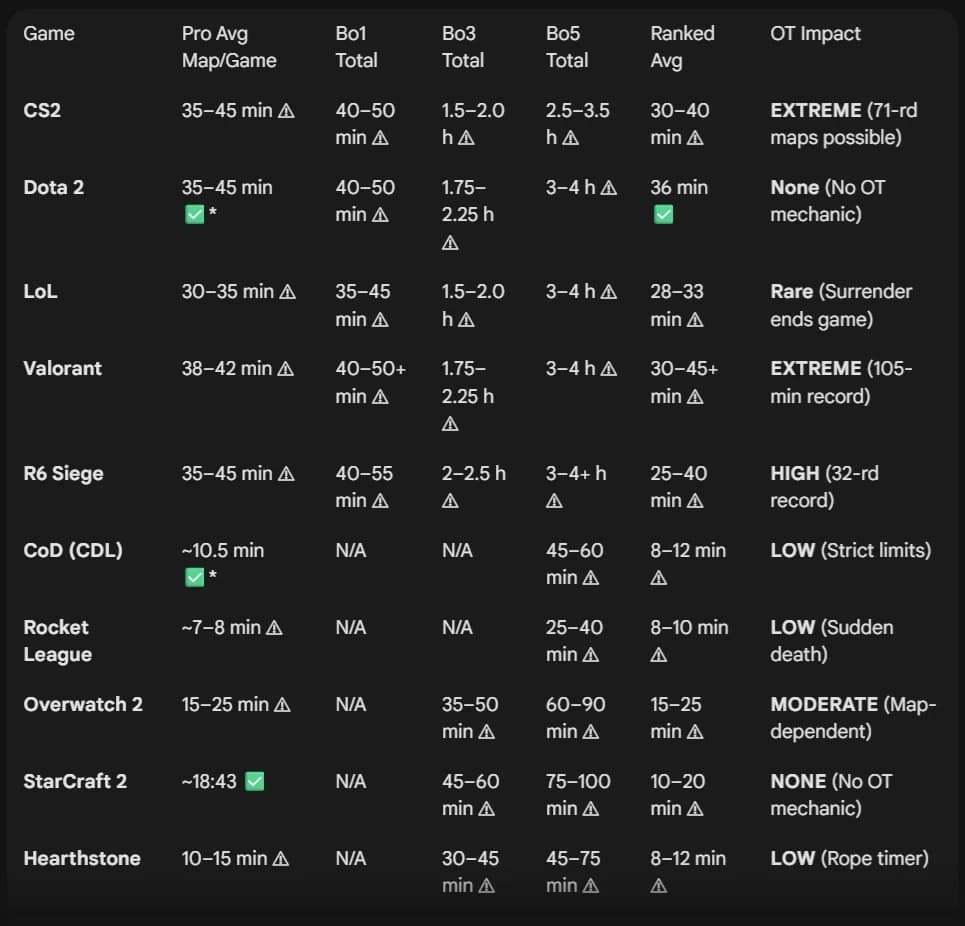
Game-by-Game Data Breakdown
To understand the average game length of an esport, one must look past the "regulation time" and into the mechanics of the meta and overtime.
CS2 (Counter-Strike 2)
The shift from CS:GO’s MR15 (first to 16) to CS2’s MR12 (first to 13) was intended to shorten the CS2 match duration, but the results have been mixed.
-
Pro Avg per Map: ~35–45 min (including tech pauses) ⚠
-
Ranked / Public: ~30–40 min ⚠
-
Overtime: Win-by-2 with MR12. This is theoretically infinite. The 71-round Anubis map at ESL Pro League Season 20 is the gold standard for "marathon" maps, running over 3 hours for a single map ✅.
-
The Lesson: While MR12 reduced map volatility in regulation, the win-by-2 OT format remains the "chaos factor" in CS2 scheduling.
Dota 2
Dota 2 is the heavyweight of the MOBA genre when it comes to time investment. Unlike tactical shooters, its duration is dictated entirely by the map's economy.
-
Pro Avg per Game: 35–45 min. However, at The International, 60+ minute "slugfests" occur in roughly 10% of matches ✅.
-
Public Ranked Median: 36 minutes across millions of matches in 2025 ✅.
-
Patch 7.40c Impact: Current data shows 90% of games finish between 23.5 and 59.5 minutes ✅.
-
The Lesson: Dota 2 has no overtime; the game ends only when an Ancient falls. This makes it highly sensitive to the "Meta"—if late-game carries are strong, expect your Sunday afternoon viewing to bleed into Monday morning.
Valorant
Valorant match duration mirrors CS2 but often feels longer due to the heavy use of utility and "stalling" abilities (Sentinels).
-
Pro Map Avg: High 30s to low 40s ⚠.
-
Confirmed Outlier: The VCT 2023 clash between Karmine Corp and BBL featured a 19–17 OT map that lasted nearly 105 minutes ✅.
-
The Lesson: Because Valorant utilizes a win-by-2 system that repeats indefinitely, it carries the second-highest "broadcast risk" for tournament organizers.
Call of Duty (CDL)
The CDL is a masterclass in high-speed broadcasting.
-
Pro Map Avg: ~10.5 minutes for Hardpoint (specifically 632 seconds) ✅.
-
Format: The standard Bo5 series (Hardpoint, S&D, Control) usually concludes in 45–60 minutes ⚠.
-
The Lesson: CoD is the shortest major "Best of 5" in esports. Its strict round limits and scoring caps make it incredibly predictable for television-style scheduling.
The Counter-Intuitive Insight:
Total series time often inverts the ranking. A Rocket League Bo7 final can take 50+ minutes, while a one-sided StarCraft 2 Bo3 can wrap up in 30 minutes. If you are planning your day around a broadcast, always look at the series format first, then the game type.
When it comes to the "grind" of professional play, match durations vary wildly by genre. In 2026, we’ve seen some absolute marathons that have tested the physical and mental limits of even the top-tier pros.
Here is the breakdown of the average and record-breaking match lengths across the major titles:
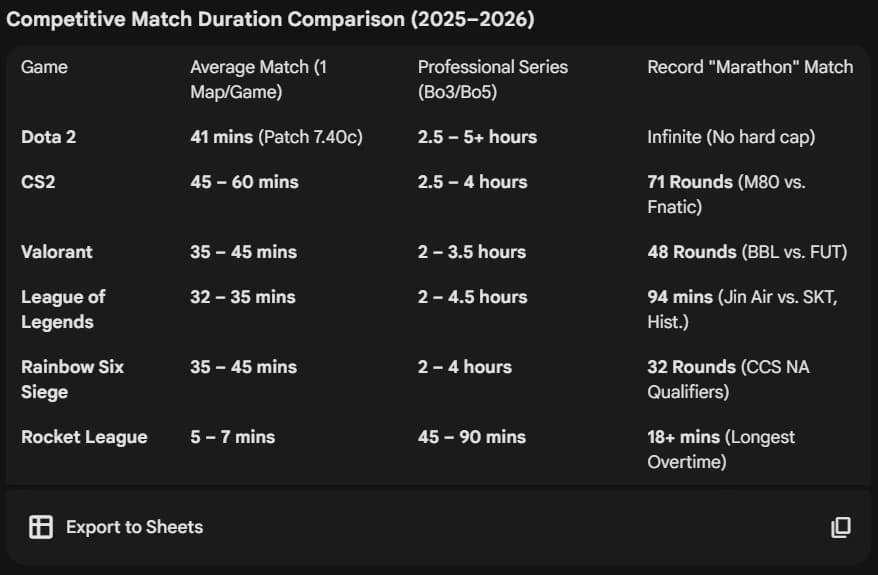
The Current Scene Highlights
-
CS2 Record Breaker (2024–2026 era): In late 2024 at ESL Pro League Season 20, M80 and Fnatic played a staggering 71-round map on Anubis. It lasted over 3 hours for a single map, even requiring a rare mid-map "bathroom break" for the players at round 60.
-
Dota 2 Dynamics: With the current 7.40c patch, games are averaging 41 minutes. However, because Dota 2 lacks a "draw" or "round cap" system, pro matches frequently spiral into 60-70 minute sieges if neither team can crack the high ground.
-
The Valorant "Never-Ending" OT: While Valorant matches are usually snappier than CS2, the BBL vs. FUT match at VCT EMEA stands as a record at 48 rounds, pushing nearly 2 hours for one map.
-
Rocket League: Though the base game is only 5 minutes, professional overtimes can triple that. In the RLCS, an 18-minute overtime is essentially three full games played back-to-back without a single mistake allowed.
Fastest vs Longest: A Ranked Comparison

When it comes to the esports game duration comparison, the spectrum is surprisingly wide. While most viewers expect a tight 30-minute window, the reality of professional play ranges from lightning-fast sprints to grueling tactical marathons.
The Sprinters: Fastest Esports Games
If you’re looking for the fastest esports game, the crown usually belongs to the mobile sector or specific objective-based titles.
-
Rocket League: Standing as the gold standard for brevity, a standard pro match lasts exactly five minutes of game time. Even with replays and the occasional overtime, most maps wrap up in under 10 minutes.
-
Mobile Legends: Bang Bang (MLBB): Designed for on-the-go play, pro MLBB matches are often the fastest esports game in the MOBA genre, typically concluding in 12–15 minutes.
-
Fighting Games (Street Fighter/Tekken): While technically a "set" of rounds, a single game in a fighting game tournament is over in a flash, often decided in less than 180 seconds of pure mechanical combat.
The Marathoners: Which Esports Takes Longest?

On the other end of the clock, certain titles are designed as tests of attrition. When asking which esports takes longest, the conversation inevitably turns to "Big Three" PC titles where complex economies and defensive structures slow the pace.
-
Dota 2: This is frequently the answer to which esports takes longest at the per-map level. While the average is 40–45 minutes, it is not uncommon for pro maps to exceed 60 minutes. The record for a single pro map stands at a staggering 5 hours (though that involved a fair amount of "stalling" bugs).
-
Counter-Strike 2 (CS2) & Valorant: These tactical shooters operate on a round-based system. A standard map usually lasts 40–50 minutes, but if a game goes into multiple overtimes, players can be locked in for over 90 minutes on a single map.
The Key Insight: Series Time vs. Map Time

It is vital to distinguish between a single game (map) and a total series. A "faster" game like Valorant can actually result in a much longer broadcast than Dota 2 if the series goes to a full five maps (Bo5).
A standard Best-of-5 in League of Legends can easily span 5 hours including breaks, whereas a Best-of-1 in Dota 2—despite being a "longer" game—is over in an hour. When planning your viewing schedule, always check the format; the number of maps is often more predictive of your time commitment than the game's internal clock.
Meta and Patch Influence on Match Duration
In the world of competitive gaming, time is not a constant; it is a variable controlled by developers. For "living" games like MOBAs and tactical shooters, the esports meta game length is often a direct reflection of the most recent balance patch. Over the last few years, we have seen a fascinating tug-of-war between developers trying to keep broadcasts punchy and players finding new ways to stall for late-game insurance.
The Dota 2 Attrition Cycle
Historically, the Dota 2 average game length has been the most volatile in the industry. Around 3–5 years ago, "deathball" metas—where teams would group up early and end games in 20 minutes—led Valve to implement massive defensive buffs to high-ground structures and the introduction of "Aghanim's Shards" to bolster mid-game power.
These changes, while balanced, pushed the average pro match closer to the 40–45 minute mark. In more recent patches (approximate data based on 2024–2025 trends), the introduction of larger maps and more neutral objectives has created a "macro-meta." Teams now spend more time traversing the map and securing resources, meaning that while the action is more frequent, the definitive "end" of the game often takes longer to reach.
League of Legends: The 30-Minute Target
Riot Games has been much more surgical with LoL match duration. For the past several seasons, Riot has openly tuned the game toward a 30-to-35-minute completion window.
-
The "Snowball" Era (Approx. 2022): Patches focused on "Durability Updates" to stop games from ending too quickly due to one-shot kills.
-
Modern Refinement (2024–2026): Recent adjustments to "Objective Bounties" and "Void Grubs" (early-game objectives) were designed to force teams to fight early.
Currently, the average esports meta game length in League remains remarkably stable, rarely drifting more than 2–3 minutes away from that 30-minute sweet spot. If a patch inadvertently causes games to routinely cross 40 minutes, Riot typically intervenes with "hotfixes" to buff tower-taking speed or jungle gold.
Why Patches Matter
Ultimately, match duration is a balancing act. If a game is too short, it feels "cheap" or uncompetitive; if it’s too long, it becomes exhausting for both players and viewers. When you see a sudden shift in LoL match duration or a spike in 60-minute Dota epics, it’s rarely an accident—it’s the game’s "internal clock" being rewound by the latest set of patch notes.
Viewer Fatigue and Broadcast Scheduling
For tournament organizers and media professionals, esports match duration is more than just a game statistic—it is a logistical puzzle. Mastering esports broadcast scheduling requires a delicate balance between the physical limits of the players and the attention spans of a global digital audience.
The Scheduling Nightmare
Unlike traditional sports with fixed clocks, esports titles like Counter-Strike 2 or Dota 2 present a "variable window" challenge. A Best-of-3 series could conclude in two hours or stretch to five. This unpredictability creates significant friction for esports broadcast scheduling, often leading to "dead air" during quick sweeps or exhausting 14-hour broadcast days when multiple series go the distance.
The Paradox of Viewer Fatigue
Credits: ESL One
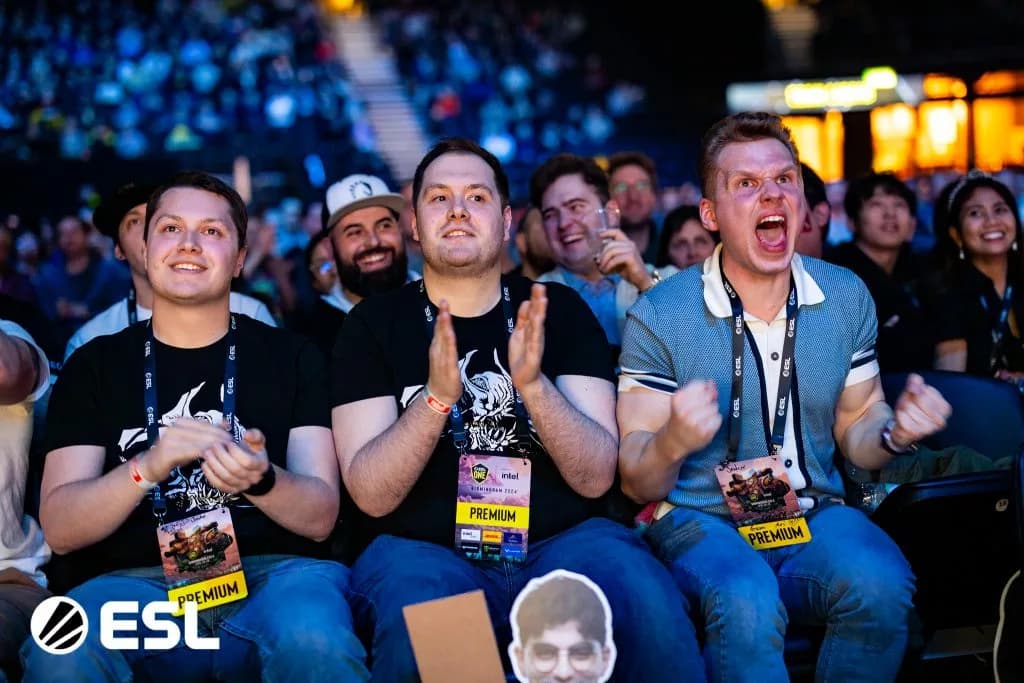
Data from platforms like Esports Charts suggests that the average viewer session for many top-tier titles sits under 30 minutes. This indicates a high level of "drop-in, drop-out" behavior, where fans check scores on social media and only tune in for the climax. Viewer fatigue in esports is a very real threat; as a broadcast crosses the six-hour mark, concurrent viewership often dips as fans in different time zones drift away.
However, the relationship between duration and satisfaction is far from linear. While long matches can cause fatigue, "marathon" games often generate the most engagement. For instance, the legendary overtime battles on maps like Anubis in CS2 were among the most-watched moments of 2024. These extreme durations transform a standard match into a "prestige event," creating a narrative of endurance that captures the community’s imagination.
The VOD and Highlight Pivot
Because of these duration hurdles, the industry is seeing a massive shift in consumption habits. While the "hardcore" fan stays for the five-hour epic, a growing majority of the audience now relies on post-match VODs and condensed highlights. For organizers, this means the live broadcast is just the first phase of content; the real "tail" of the esports match duration is found in the millions of views generated by 10-minute recap videos the following morning.
AQ: Frequently Asked Questions about Esports Durability
Here is a quick guide to the most common questions regarding esports match duration and scheduling.
Which esports game has the longest match duration?
While typical rounds of Dota 2 and League of Legends cluster between 30–45 minutes, tactical shooters like CS2 and Valorant produce the longest individual maps when overtime is triggered. A single CS2 map at ESL Pro League Season 20 famously reached 71 rounds and lasted over three hours. Consequently, the esports match duration for these titles is the most unpredictable in the industry.
How long is a CS2 match?
On average, a single professional map takes approximately 35–45 minutes to complete. However, because the win-by-two overtime format has no hard cap, players and viewers must be prepared for extreme outliers that can exceed three hours. When planning your schedule, a standard Best-of-3 series usually spans 1.5–2 hours, while a Best-of-5 can run between 2.5 and 3.5 hours.
What is the Dota 2 average game length?
According to large-sample data from Dotabuff, the Dota 2 average game length for public ranked matches is approximately 36 minutes. In the professional circuit, this shifts slightly higher to 35–45 minutes, with high-stakes matches at The International frequently crossing the 50-minute mark. Under the current 7.40c patch, the public average has settled at a slightly more exhaustive 41.0 minutes.
Which esports game is the fastest to watch?
Rocket League is undisputed as the fastest esports game to watch, featuring a fixed 5-minute game clock that results in roughly 7–8 minutes of real-time action per map. This allows an entire Best-of-5 RLCS series to conclude in under 40 minutes. Call of Duty (CDL) follows closely, with individual maps typically wrapping up within 10–12 minutes.
How do esports overtime rules affect match duration?
The impact of esports overtime rules varies wildly depending on the title's mechanical constraints. In CS2 and Valorant, the uncapped win-by-two format can cause matches to double or triple in length, as seen in the 105-minute Valorant marathon during VCT 2023. Conversely, Rocket League uses a swift sudden-death OT, and Call of Duty employs strict score limits to ensure the broadcast stays on track.
Conclusion: The Future of Esports Timing
As the industry matures, the science of esports match duration has become as critical as the gameplay itself. Understanding how long a broadcast will run is no longer just a concern for fans—it is a foundational requirement for sponsors, broadcasters, and professional athletes. To summarize the landscape of modern competitive gaming, here are the five definitive takeaways:
-
Format Over Game Design: Ultimately, the format determines the duration more than the underlying engine. Titles like Call of Duty utilize strict internal clocks to ensure matches stay on schedule, whereas the "win-by-two" overtime rules of CS2 allow for theoretically infinite play, proving that rulesets often override game mechanics.
-
The Series vs. Map Paradox: Total series time and per-game time are fundamentally different questions. Interestingly, the average game length of the fastest title, Rocket League, can result in a longer Best-of-7 (Bo7) series than a Best-of-3 StarCraft 2 matchup. When calculating your viewing time, the number of maps in the format is the most important variable.
-
The Volatility of MOBAs: Dota 2 and League of Legends remain uniquely meta-sensitive. Because their win conditions are tied to player scaling and economy, a single balance patch can shift the average game length by 5–10 minutes without a single official rule change.
-
The Outlier Factor: Tactical shooters like CS2 and Valorant produce the most extreme individual-match outliers. Because their overtimes are structurally uncapped, a single map can occasionally double its expected esports match duration, creating "prestige" marathons that defy standard scheduling.
-
The Path Toward Standardization: As esports continues its trajectory as a premier broadcast product, format standardization—such as round caps or fixed tie-breaker clocks—will become increasingly vital. For the sake of scheduling reliability and reducing viewer fatigue, the "infinite" match may soon become a relic of the past.
Factors That "Stretch" the Clock
-
Overtime Rules: In games like CS2 and Valorant, the "Win by 2" rule in overtime can lead to infinite loops if teams are perfectly matched.
-
Objective Scaling: In LoL and Dota 2, if the "late game" buffs (like Baron or Aegis) don't lead to a finish, the game enters a stalemate where one mistake costs the entire series.
-
Tactical Timeouts: Modern pro rules allow for multiple 30-60 second timeouts, which, combined with technical pauses, can add 20-30 minutes of "dead air" to a broadcast.
Read more: PGL Wallachia Season 7: Format, Schedule, Fixtures and More
Featured Image Source: ESL